BOPA AI Blog: Finding the Balance – Responsible AI Use for Students
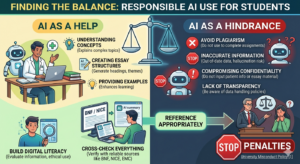
As artificial intelligence (AI) becomes increasingly common in clinical settings, it is also being adopted by pharmacy students to help streamline their experience at university. When used appropriately, AI can clarify concepts and improve accessibility for students. However, it comes with limitations, particularly surrounding plagiarism, confidentiality, and the risk of inaccurate or outdated information.
AI is a powerful tool, but it can be difficult to know how to use it responsibly. The following considerations can help ensure its safe and effective use.
Using AI for understanding, not answering
AI cannot replace human judgement, which is why your work will always be stronger when it reflects your own thinking. AI is useful for explaining concepts or providing examples, but it should not be used to complete assignments.
For example, rather than asking AI to write a reflective essay based on your hospital placement, it may be more appropriate to:
– explore existing reflective models, or
– generate headings and themes based on the points you wish to discuss
This approach supports learning while maintaining academic integrity.
Cross-check everything
AI can produce outdated or incorrect information. In pharmacy, where guidelines are constantly evolving and new evidence is continually emerging, this presents a clear risk.
It is essential to verify any AI-generated content using reliable, evidence-based sources such as:
– the British National Formulary (BNF)
– National Institute for Health and Care Excellence (NICE) guidance
– the electronic Medicines Compendium (EMC)
Be transparent
It may be tempting to assume that AI use will go unnoticed; however, as its use becomes more widespread, academic institutions are becoming increasingly aware of how to identify AI-generated content. Tools such as Turnitin are also evolving in this area.
Students should review their university’s policies and acknowledge AI use where appropriate to avoid academic misconduct. For example, the University of Huddersfield states that where AI use is permitted, it should be referenced appropriately, and misuse may result in academic penalties [1].
Be aware of privacy and confidentiality
A key concern with AI relates to data privacy, particularly around how information entered into these systems may be stored or used. There is often limited transparency regarding data handling.
Students should:
– avoid entering identifiable patient information
– avoid uploading sensitive academic material
AI-generated content may be considered part of the public domain, which can compromise confidentiality and the integrity of academic or professional work if misused.
Build digital literacy
Digital literacy in the context of AI involves critically evaluating the information provided and ensuring its ethical and effective use.
Using AI as a study aid is not inherently problematic; however, how the information is used is what matters. Students should consider:
– the accuracy of the information
– the limitations of the tool
– the impact on academic integrity
Looking ahead
As AI continues to evolve, its role within education will also change. The most effective students will be those who use it to deepen their understanding while maintaining academic integrity.
Responsible AI use does not mean limiting the technology; rather, it involves developing the judgement to use it appropriately—using AI as a support, not a substitute.
Pharmacy is a profession that requires lifelong learning. Keeping up to date with developments such as AI is essential, although it may feel unfamiliar at first.
Students are encouraged to use AI to better understand AI itself—exploring its strengths, limitations, and appropriate applications in both academic and professional settings. Developing effective prompting skills and recognising where AI may be less reliable are important aspects of this learning.
Further resources
AI in Medicine (King’s Health Partners): https://learninghub.kingshealthpartners.org/course/aimedicine (Accessed: 6 April 2026)
Demystifying AI (King’s Health Partners): https://learninghub.kingshealthpartners.org/course/demystifying-ai (Accessed: 6 April 2026)
NHS e-Learning for Healthcare – Artificial Intelligence module: https://portal.e-lfh.org.uk/Component/Details/828665 (Accessed: 6 April 2026)
References
[1] University of Huddersfield Academic Misconduct Policy (Section 10.2.3–10.2.5): https://www.hud.ac.uk/policies/registry/regs-taught/section-10/ (Accessed: 6 April 2026)
Written by Aaliyah Bhikha, Pharmacy Student
Supported by Farah Al-sheikhli and Harry Warner, AI BOPA Advisory Group – Education and Training Co-Leads
Join the Conversation
We would really value hearing about your experiences with AI in pharmacy practice. Please feel free to share your thoughts, reflections, or examples of how AI is shaping your work within the AI Forum. Whether you are just starting out or already embedding AI into your practice, your perspective is important. If you would prefer, you can also get in touch directly to share your story—we are here to support you in bringing your experience forward.
Join the conversation through What’s Your AI Story? and help shape the future of digital pharmacy practice: What’s Your AI Story? – BOPA