BOPA Bespoke CPD Course on Health Technology Assessment (HTA)
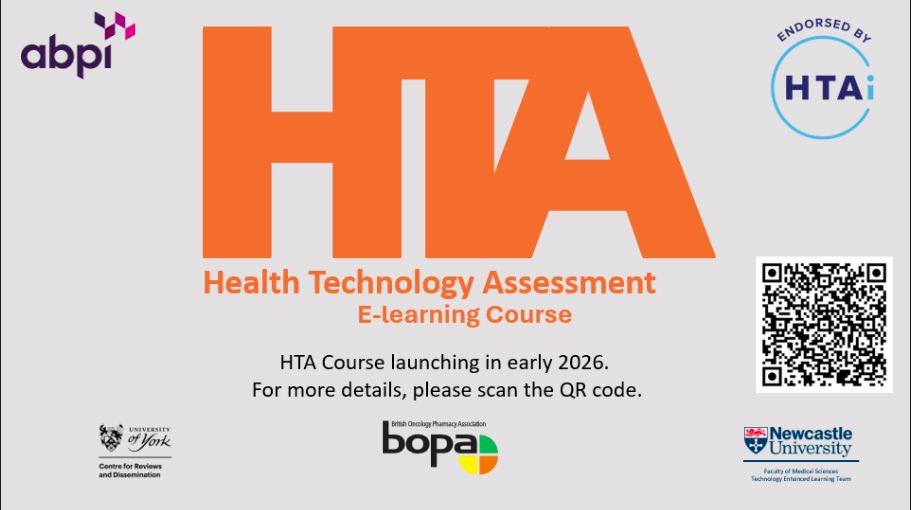
BOPA supported by expertise from the University of York and the National Institute of Health and Care Excellence (NICE) are delighted to announce this Continuing Professional Development (CPD) course on Health Technology Assessment (HTA).
This course will form part of the BOPA passport scheme of core training accreditation for the 3,000+ professionals working in pharmacy services across the National Health Service (NHS) in the United Kingdom.
The course will provide standardisation information on HTA across NHS organisations/trusts through knowledge accreditation. The course is endorsed by Health Technology Assessment International (HTAi).
Course Delivery
The course will be developed by the Centres for Review and Dissemination (CRD), University of York. Also, providing expertise in market access is Steve Williamson, Associate Director for Managed Access at NICE, and a former President of BOPA.
The course will be delivered by way of eight modules on HTA that would be applicable to cancer care. Each module will be 15 to 20 minutes in length and consist of voice-over slides, animations and interviews/clips with relevant topic experts.
The aim of the course is to:
- Equip BOPA members with the knowledge of how evidence is synthesised and used in an economic model in HTA
- Share insights into the key economic modelling issues within HTA
- Present how HTA and market access works in practice across the UK. Focusing on the NICE approach to commissioning new cancer medicines but also the Scottish Medicines Consortium (SMC) and the All-Wales Medicines Strategy Group (AWMSG).
- Discuss managed access schemes, such as the Cancer Drug Fund (CDF)
By the end of the CPD course, a participant should be able to:
- Understand the HTA process with a focus on cancer drugs.
- Recognise the interface between the pharmaceutical industry, independent review groups (External Assessment Groups, EAGs), HTA agencies in the UK and healthcare professionals.
- Demonstrate knowledge of the methodology used in the HTA process and how this translates into market access.
The CPD course is being designed to be accessible to all learners, requiring no prior knowledge of economics, evidence synthesis or HTA. It will follow a modular format, consistent with other BOPA e-learning courses, allowing participants to learn at their own pace through clearly defined units.
| Module | Title | Details |
| 1 | Overview of HTA Process | Purpose of HTA – past, present and future. Importance of HTA to pharmacy. Fundamental principles of HTA (clinical evidence and economic evaluation). |
| 2 | Clinical Evidence for Decision-Making | Types of Clinical Evidence. Evaluating Clinical Evidence incl. meta-analyses. Indirect treatment comparisons – (Network MA) and more advanced topics of indirect comparisons (MIAC, ML-NMR). |
| 3 | Economic Evaluation | What is an economic evaluation? Types of economic evaluation used by HTA agencies and examples in cancer care. Cost-Effectiveness Threshold. |
| 4 | The NICE HTA process – STA for cancer drugs | The HTA Process in England. Types of NICE technology appraisals. NICE Reference Case; Types of NICE recommendations. Stakeholder perspectives. |
| 5 | EAG Exemplar | What is an External Assessment Group (EAG)? The NICE STA Timeline. Key issues in an EAG report. NICE Committee. NICE Recommendations. |
| 6 | NICE HTA Process – Cancer diagnostics & MedTech | Cancer Diagnostics and HealthTech. NICE Programme – DAP for Diagnostics. HealthTech Programmes MTEP, HST, EVA and LSA. NHS 10-year plan. HealthTech Manual (Forthcoming). Stakeholders’ perspectives. |
| 7 | SMC and AWMSG | What happens in Scotland/Wales/NI? Compared to NICE HTA Process. |
| 8 | Market Access | Post Recommendations – Role of the Cancer Drugs Fund (CDF). Hospital Pharmacists (BlueTeq); SACT database; Regional and Local commissioners. |
From Our Stakeholders
“We are delighted to see the launch of the BOPA Health Technology Assessment (HTA) course, which represents an important step forward in supporting the cancer pharmacy workforce to engage confidently with medicines evaluation and decision-making processes.
“As cancer treatments become increasingly complex and innovative, it is essential that cancer pharmacy professionals are equipped with the knowledge and skills to critically appraise evidence, understand HTA frameworks, and contribute meaningfully to national and local decision-making. This course has been designed to build that capability and empower pharmacy staff to play a stronger role in shaping the future of cancer care.
“We are extremely grateful to the HTA team at the University of York and Steve Williamson (NICE), who have worked hard to develop this programme. Their efforts will help ensure that pharmacy professionals across the UK are better supported to navigate HTA processes and advocate for safe, effective, and equitable access to cancer medicines for patients.
“We look forward to seeing the impact this course will have in strengthening the expertise and leadership of our profession.”
Shereen Nabhani-Gebara, BOPA chair
Joe Williams, BOPA past-chair / vice chair
Michal Sladkowski, BOPA vice chair elect
“Written and delivered by experts with years of experience, this course delivers a comprehensive overview of UK health technology assessments. Focusing on cancer drugs and NICE appraisals, it provides clearly presented descriptions and explanations of all the key processes, stages and components of NICE appraisals, including evidence synthesis and health economic modelling.”
Mark Corbett, NICE Committee Member
“The Technology Assessment Group at the University of York are delighted to share their insights into how HTA is operationalised in the UK. We believe that it is important that all healthcare professionals involved in cancer care in the NHS are familiar with the reimbursement process. We see BOPA as pioneers in this regard and we hope that BOPA members will embrace and enjoy this CPD course on HTA.”
Sofia Dias, Professor of Evidence Synthesis and HTA at the Centre for Reviews and Dissemination, University of York and Director of the York Technology Assessment Group